Scope
This page is a practical guide for configuring the CRM MCC rheology in Chrono::FSI-SPH.
It focuses on:
- physical intuition for each MCC parameter
- exact API calls used in Chrono
- code-level behavior of the return-mapping implementation
- two calibration workflows:
- classical geomechanics test-based identification
- empirical Chrono calibration when only interaction tests are available
Primary references:
- Itasca Cam-Clay documentation (parameter interpretation and classical calibration):
https://docs.itascacg.com/itasca900/common/models/camclay/doc/modelcamclay.html - Chrono MCC implementation files:
src/chrono_fsi/sph/physics/SphFluidDynamics.cu,
src/chrono_fsi/sph/physics/SphForceWCSPH.cu,
src/chrono_fsi/sph/physics/SphDataManager.cu
Model Sketch
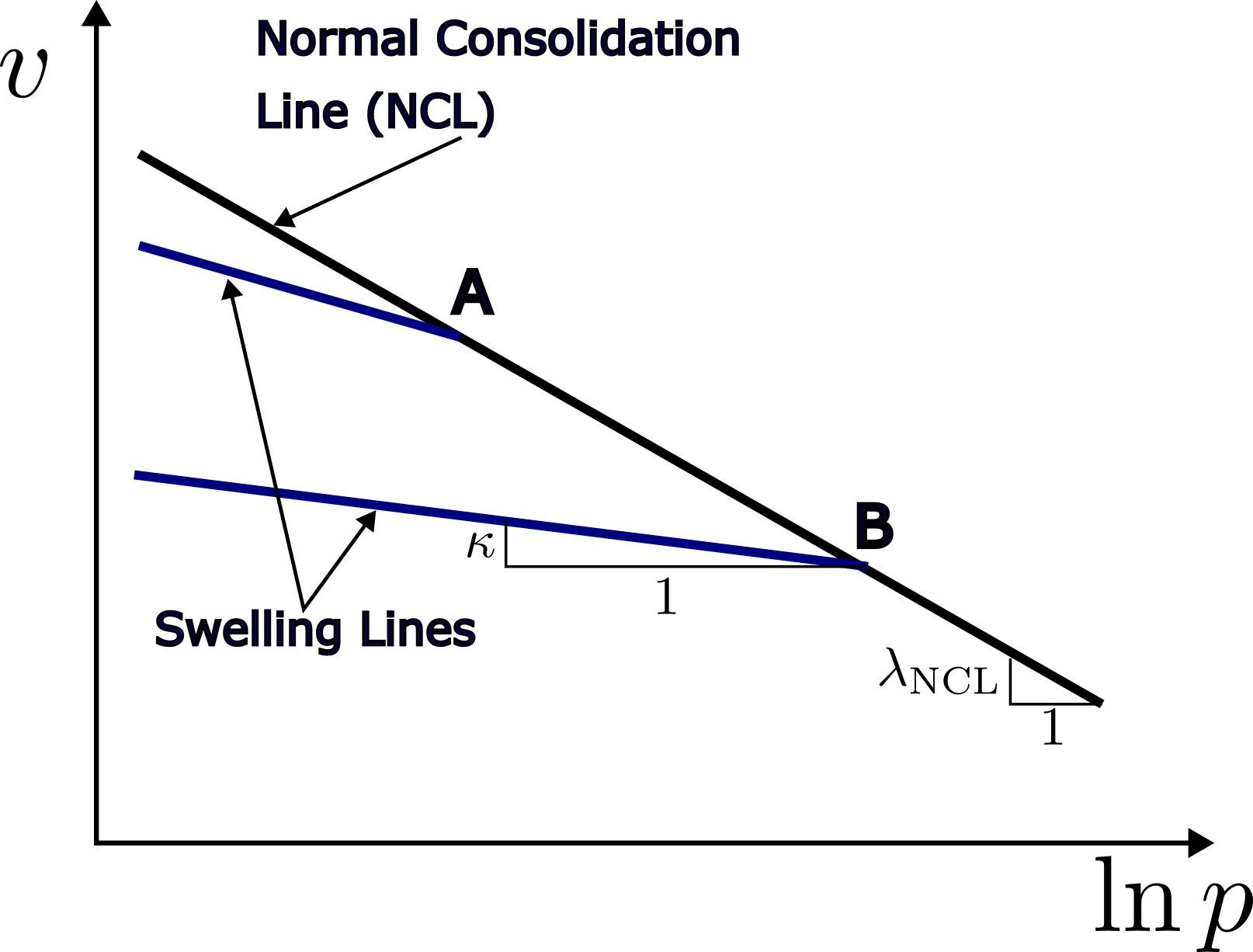
Normal consolidation and swelling behavior in v-ln(p) space.
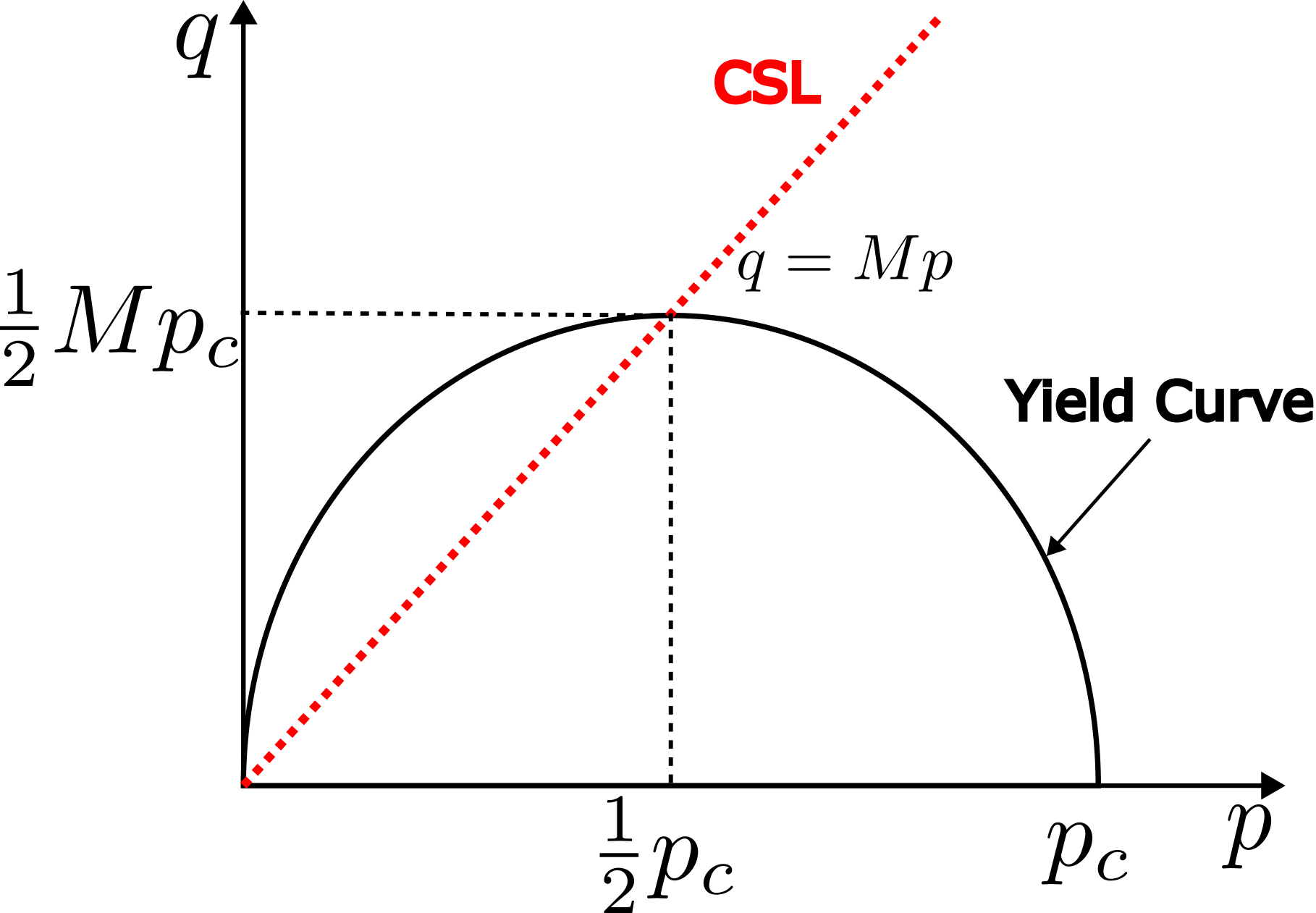
MCC elliptical yield surface in p-q space with CSL slope M and cap size p_c.
Quick Start
- Set
rheology_model = RheologyCRM::MCC. - Set all MCC constitutive parameters explicitly:
mcc_M,mcc_kappa,mcc_lambda,mcc_v_lambda. - Initialize per-particle preconsolidation pressure
p_c0(viapcinAddSPHParticle, or callback-based scaling). - Reuse SPH solver settings from
manual_fsi_sph_parameter_selection(especially artificial viscosity, shifting, free-surface handling, and time-step strategy).
API Map (How To Set MCC Parameters)
Constitutive parameters are set through SoilProperties:
Important: p_c0 is not in SoilProperties. It is per particle and passed through pc at particle creation:
If you use ChFsiProblemSPH with a properties callback:
Code-level note:
- In
ChFsiProblemSPH.cpp,pcis built asp0 * pre_pressure_scale0. - In direct
AddSPHParticle, you providepcexplicitly.
MCC Math-to-Code Map
Chrono's MCC branch is implemented in TauEulerStep(...) (SphFluidDynamics.cu) and uses stress-rate terms from CrmRHS(...) (SphForceWCSPH.cu).
| Concept | Implementation detail |
|---|---|
| Trial stress | sig_N_tr = sig_n + dt * deriv_sig in TauEulerStep(...) |
| Invariants | p = -(1/3)tr(sigma), q = sqrt(3 J2) |
| Yield function | f = q^2 + M^2 p (p - p_c) |
| Elastic moduli | K = v p / kappa, G = 3K(1-2nu)/(2(1+nu)) (then clamped) |
| Plastic correction | quadratic solve for delta_lambda, return to yield surface |
| Hardening | p_c <- p_c * (1 + delta_eps_vp * v / (lambda - kappa)), with floor |
| Tension handling | if trial/corrected p < 0, stress is zeroed |
| Free-surface handling | stress and pressure zeroed for free-surface flagged particles |
Current Chrono safeguards (important for interpretation):
KandGare clamped to[0.1, 1.0]of reference values derived fromEandnu.p_chas a hard floor (>= 100 Pain current code).- Free-surface particles skip hardening updates and are stress-zeroed.
- EOS is not used in CRM; pressure is obtained from stress (
p = -(1/3)tr(sigma)).
Core MCC Parameters
Set these through SoilProperties, plus per-particle pc.
| Parameter | Physical meaning | Code default | Practical recommendation | API |
|---|---|---|---|---|
mcc_M | Critical state line slope (q = M p), controls shear strength at critical state. | 0 | Set from triaxial data or friction angle mapping. Typical terramechanics starts are about 0.8-1.4. | mat_props.mcc_M -> SetCrmSPH |
mcc_kappa | Swelling/recompression slope in v-ln(p); controls elastic volumetric stiffness (K ~ v p / kappa). | 0 | Must be positive and usually smaller than lambda; increasing kappa softens elastic reload response. | mat_props.mcc_kappa -> SetCrmSPH |
mcc_lambda | Normal consolidation slope in v-ln(p); controls virgin compressibility and hardening rate. | 0 | Must exceed kappa; larger lambda gives more compressible virgin response. | mat_props.mcc_lambda -> SetCrmSPH |
mcc_v_lambda | Specific volume intercept at reference pressure p1 = 1000 Pa. | 2.0 | Set from isotropic compression line intercept in v-ln(p) space. | mat_props.mcc_v_lambda -> SetCrmSPH |
pc (per particle) | Initial preconsolidation pressure p_c0; sets initial yield cap size / OCR effect. | 1e3 in AddSPHParticle signature | Set from OCR/test data or use depth-dependent p0 * pre_pressure_scale. This is highly influential in penetration/sinkage response. | AddSPHParticle(..., pc) or callback pre_pressure_scale0 |
density | Bulk density scale for inertia and pressure/stress coupling. | 1000 | Use measured bulk density for intended initial state. | mat_props.density -> SetCrmSPH |
Young_modulus, Poisson_ratio | Reference elastic moduli used to compute K_bulk and G_shear and clamping bounds. | 1e6, 0.3 | Keep physically plausible; very large E can force smaller stable steps in explicit integration. | mat_props.Young_modulus, mat_props.Poisson_ratio -> SetCrmSPH |
Critical consistency checks:
mcc_kappa > 0mcc_lambda > mcc_kappa(hardening denominator useslambda-kappa)mcc_M > 0mcc_v_lambda > 0pc > 0and initialp0 > 0where NCL-based initialization is used
The first four are enforced. ChFsiFluidSystemSPH::CheckSPHParameters(), which runs during Initialize(), rejects a violating configuration with a std::runtime_error rather than letting it run; all four parameters are also required to be finite. The pc and p0 condition is checked separately, per particle, in ChFsiFluidSystemSPH::AddSPHParticle().
The same function additionally reports, without rejecting, a lambda-kappa difference smaller than max(1e-6, 1e-3 * lambda). Such a configuration is legal, but since the hardening rate scales as 1 / (lambda-kappa), it produces a very large plastic modulus and an ill-conditioned return mapping, which is rarely what is intended.
Naming note:
- In current MCC equations in Chrono,
kappais used as the swelling/recompression slope andlambdaas the NCL slope. This follows standard MCC notation used in the equations and implementation.
Traditional Parameter Selection (Physical Tests)
This is the standard CSSM/MCC workflow used in geomechanics (see Itasca reference above).
- Isotropic compression + unload/reload tests:
- Fit
v-ln(p)lines. lambda= slope of normal consolidation line (NCL).kappa= slope of swelling/recompression lines.v_lambda= intercept at reference pressurep1(Chrono usesp1 = 1000 Pain initialization code).
- Fit
- Triaxial tests to determine critical state slope:
M = q/pat critical state.- If only friction angle
phiis available (triaxial compression convention), a common mapping is:M = 6 sin(phi) / (3 - sin(phi)). - Equivalent Itasca form:
N_phi = (1 + sin(phi)) / (1 - sin(phi)),M = 3 (N_phi - 1) / (N_phi + 2).
- Initial cap size from stress history:
- Set
p_c0from isotropic yield stress or OCR:p_c0 = OCR * p0.
- Set
Useful conversion if lab data is in void ratio:
v = 1 + e- if using compression/recompression indices from
e-log10(p)data, typical conversions are:lambda = Cc / 2.303,kappa = Cr / 2.303
Empirical Chrono Calibration Workflow (When Lab Data Is Missing)
- Set
Mfirst from a target friction angle (or a prior material estimate). - Set
kappa,lambda, andp_c0to match penetration/sinkage compliance and hardening trends. - Use complementary tests (for example Cone Penetrometer Test + Normal Bevameter Plate Sinkage Test) to reduce parameter ambiguity.
- Keep SPH numerics fixed while tuning constitutive parameters (see
manual_fsi_sph_parameter_selection).
Interpretation while tuning:
- Increase
lambda: softer virgin compression, larger settlement. - Increase
kappa: softer elastic unload/reload response. - Decrease
(lambda-kappa): fasterp_cgrowth under plastic compaction (faster hardening). - Increase
p_c0: larger initial elastic domain (stiffer early response). - Increase
M: higher shear resistance for given mean pressure.
Current Defaults and Demo Ranges
Current constructor defaults for MCC-specific fields are:
mcc_M = 0mcc_kappa = 0mcc_lambda = 0mcc_v_lambda = 2.0
These defaults are placeholders and are not physically usable for MCC without explicit user input.
Values seen in Chrono demos span a broad range depending on scenario scale:
mcc_kappa: about0.01up to0.2mcc_lambda: about0.02up to1.0M: often computed from a chosen friction coefficient/anglepre_pressure_scaleforp_c0: from about2(large-scale terrain) to much higher in penetration-focused setups
Hard-coded Specific-Volume Initializer (Current Code)
Chrono currently initializes specific volume (Sv) in FsiDataManager::AddSphParticle using:
Sv = v_lambda - lambda * ln(pc / p1) + kappa * ln(pc / confining_stress)- with hard-coded
p1 = 1000 Pa - and
confining_stress = pres(the particle's initial pressure)
Location:
src/chrono_fsi/sph/physics/SphDataManager.cu
Implications:
- This initializer is always executed at particle insertion.
- It assumes positive
pcand positivepres(to avoid invalid logarithms). - If you initialize particles with near-zero pressure or leave
pcat nonphysical values, MCC state initialization can be inconsistent.
Practical guidance:
- In MCC runs, initialize particles with physically meaningful
p0andpc0. - Keep
pc0consistent with your intended OCR/state profile (depth-dependent if needed). - Set
mcc_v_lambdaexplicitly when you havev-ln(p)calibration data.
Common Failure Modes and First Fixes
- Very soft early response: increase
p_c0and/or reducelambda. - Overly stiff response with little plasticity: reduce
p_c0, increaselambda, or reduceM. - Unstable volumetric behavior: verify
lambda > kappa > 0, and reduce step size (or use variable time step). - Free-surface particles carrying unphysical stress: check
free_surface_thresholdand keep CRM free-surface handling enabled.